
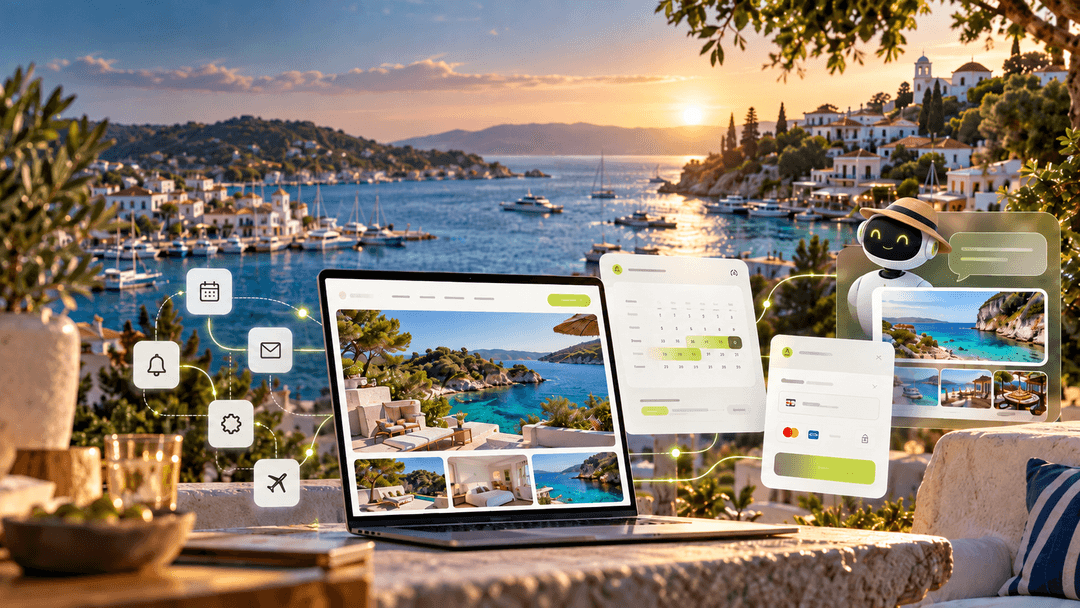
Across the Sporades Islands from Skiathos to Skopelos and beyond businesses compete on more than just price or customer experience. They also compete on how quickly they respond.
A traveler searching for "Skopelos and Skiathos" on their phone while standing at the port isn't going to wait two days for an email response.
Skiathos Travellers started with exactly this observation.
The idea was simple: How can a local tourism business provide personalized recommendations, bookings, and local insights as if it had an entire team behind it without actually needing one?
The journey from that initial idea to today's digital system is one of the most valuable case studies we can share.
Because it wasn't just a technological decision. It was a series of operational decisions.
The First Mistake Almost Every Island Business Makes
Most businesses on Greek islands treat their website as a finished product.
They build it, launch it, and wait for customers.
When customers don't arrive, they conclude that "digital marketing doesn't work on the islands."
But a website doesn't deliver results simply by existing.
What works is the system behind it: a website, booking processes, automation, AI, content, and advertising all connected so that each component supports the next.
With Skiathos Travellers, this became clear from the beginning.
The idea was strong. What it needed was the right infrastructure.
Step 1: A Website Built with Performance-First Architecture, Not Just Attractive Design
The first thing we built wasn't the design. It was the architecture.
On an island, one of the biggest technical challenges is connectivity.
Visitors browse on their phones, often with unreliable mobile reception, whether they're sitting at a beach bar or traveling on a ferry.
If your website takes three seconds to load, you risk losing potential customers before they even see what you offer.
Building a website for this type of business requires specific technical priorities: fast rendering, optimized images, mobile-first user experience, and a clear structure that search engines can understand.
Looking good isn't enough. It has to work.
Step 2: Bookings and Payments Without Manual Work
The next decision was more challenging because it initially sounded more expensive: integrating automated bookings and online payments from day one.
The temptation was to start with a simple approach: "Send us an email, and we'll arrange everything."
But that creates an invisible operational cost.
Every reservation requires manual intervention. Every modification involves phone calls or messages. And the business cannot grow without hiring additional staff.
For a seasonal tourism business, this can mean working 14-hour days during summer while having very little useful data to analyze during winter.
With an integrated booking and payment system, the same team can serve three times as many customers and every reservation generates valuable data that can support future business decisions.
Step 3: Automation That Removes Work Instead of Adding More Tools
This is where many businesses make the opposite decision from what they actually need.
They keep adding tools.
Five different apps, three separate platforms, and a spreadsheet that nobody remembers to update.
The most useful business automations are often simple and invisible:
- Booking confirmations and reminders sent automatically.
- Availability synchronization to prevent double bookings.
- Post-service questionnaires that feed directly into a dashboard instead of getting lost in an inbox.
- Reports automatically delivered every Monday without anyone having to request them.
None of these features may seem particularly impressive on its own.
Together, however, they free up hours every week time that can be redirected toward activities that generate revenue.
Step 4: An AI Agent That Responds Like a Local
The feature that made this project stand out was its AI Agent, ARIA.
ARIA isn't a basic chatbot that responds with "I couldn't find that information."
It's an intelligent system designed to make recommendations, assist with bookings, and provide local insights based on the business's actual content.
The difference is significant.
An AI Agent without structured data behind it is little more than an expensive gadget.
An AI Agent built on a solid foundation with properly organized content, availability, pricing, and location information becomes a digital assistant that never sleeps.
For an island tourism business, this can make an immediate difference.
Customer questions arrive at all hours, in multiple languages, and often when no staff member is available to respond.
What Actually Changed
The most important result wasn't technical.
It was that the business developed something similar to an operational memory.
Every booking, customer question, and guest preference can be recorded and used to improve future decisions.
This means the next tourism season doesn't start from zero. It starts with data.
The business can understand which services are most popular, which countries its customers come from, and where visitors leave the website without completing an action.
The same principle applies to organic visibility.
SEO for small businesses in Greece isn't magic. It's consistency.
A clear website structure, fast performance, and content that answers real customer questions create the foundation for stronger search visibility.
When the fundamentals are right, better search rankings can follow.
What We Would Do the Same If We Started Today
- Start with operations, not appearance. Which processes do we want to stop handling manually?
- Build the website as the center of the system. Performance should be a requirement, not a luxury.
- Integrate payments and bookings early. Avoid creating a temporary phase where everything depends on manual work.
- Introduce automation only where it saves time. Never add technology simply to impress.
- Build the AI Agent last. It should operate on top of properly structured data and established processes.
The Conclusion
Skiathos Travellers didn't succeed because it adopted some groundbreaking new technology.
It succeeded because it stopped treating digital development as a collection of separate projects and started approaching it as one interconnected system.
And that's the most transferable lesson for businesses operating on Greek islands from Skiathos and Skopelos to the Cyclades and Crete.
You don't need more tools. You need fewer tools that work better together.
At Hustle Labs, we don't believe in one-size-fits-all solutions.
Every digital system is designed around how a business actually operates and then built to handle seasonal demand, increasing workloads, and changing requirements.
If you have an idea and you're wondering where to begin, the first step isn't design.first step isn't design.